Friday, May 8, 2015

Gouvernance participative

Un message respectueux adresse au Ministre Nazem Khoury et conseiller du Président Sleiman tout au long de son mandat. http://www.lorientlejour.com/article/923985/pourquoi-le-dialogue-.html

Votre Excellence, Cet article que j'ai lu et relu m'avait attiré parce qu’il recommande le dialogue dont je suis un partisan inconditionnel.

 N’empêche que lire que 142 réunions se soient tenues durant le terme du mandat Sleiman a grandement refroidi mon enthousiasme. Cela veut dire qu'au rythme de 2 par mois durant six ans, ces réunions n'ont abouti a pratiquement rien. Pourquoi?

 Les multiples "postings" dont j'ai inondé votre page personnelle sur Facebook, durant plusieurs années, expliquaient pourtant assez clairement ce phénomène. C'est vraiment dommage, pour notre Liban, qu'on ne se soit pas assez attarde à les considérer.

Non, votre Excellence, ce n'est pas de la suffisance de faire une telle déclaration.  Une seule approche peut servir à résoudre nos problèmes au Liban, et je n'en démordrai jamais. C'est la "GOUVERNANCE PARTICIPATIVE".

PS. D’autre part, lire, pour la première fois en ce qui me concerne, que tant de réunions se soient tenues « pour rien »  m’étonne autant qu’il me désappointe. Pourquoi le PEUPLE qui est, après tout le PREMIER concerne, n’a-t-il pas été suffisamment informe du nombre considérable de ces réunions  « INFRUCTUEUSES »?


On agit dans ce pays comme si les « citoyens » à qui appartient ce pays, n’existaient pas.

 Pourquoi donc devrait- on s’étonner de toutes les catastrophes qui l’accablent ? 

Espérons que le successeur du Président Sleiman, comprenne, au départ, qu’un pays comme le Liban, accable par la corruption, l’appât insatiable du gain personnel, ainsi qu’un confessionnalisme exacerbe, ne peut être gouverne efficacement qu’à travers la « GOUVERNANCE PARTICIPATIVE » ». Les gens vont-ils enfin comprendre cette simple vérité ??????

Tuesday, May 5, 2015

POURQUOI ONT-ILS SI PEUR DES REFORMES?

03/05/2015

Pourquoi les reformes ne se sont jamais concrétisé au Liban ?

03/05/2015


Lilianne, il nous est demande à tous de découvrir la cause de notre immobilisme des dix dernières années, pour ne pas revenir plus loin en arrière. D'ailleurs, pour moi, c'est plus facile parce que je suis revenu au pays en 2005 après trente années d'absence. Depuis cette date j'ai tache, par tous les moyens, de comprendre ce qui se passe dans ce pays. Lilianne, je vais essayer de l'expliquer, au mieux de mes capacités.

 Tout d'abord, les reforme. De 2005 à ce jour il y a eu beaucoup de tentatives de ce genre menées par Aly Hassan El Khalil-Agriculture (2005), feu Pierre Gemayel-Industrie (2006), Gebran Bassil-Electricité-Eau (2009, 2010),  Hassan Mneimne-Education (2011), Nazem El Khoury-Environnement (2011). Bien avant eux, l’UNDP avait réalisé en 1992 une étude très valable du Tourisme. Chacun de ces Plans comprenait, en moyenne, une centaine d’initiatives, non seulement valables, mais essentielles pour le développement équilibré des ressources nationales et la survie des citoyens.

Qu’en est-il advenu ? RIEN, oui trois fois RIEN. Pourquoi ? C’est la réponse a cette question que je me suis attelé à rechercher depuis 2005. Ce n’est que durant les deux dernières années que j’ai pu faire la liaison directe entre ce phénomène et celui du gonflement inéluctable de notre dette publique depuis 1993.

Durant ces vingt dernières années, tous les gouvernements qui se sont succédé au Liban, à raison de deux ans en moyenne pour chacun d’eux, avaient pour consigne de laisser la Dette croitre sans essayer, à aucun moment, de la repayer, soit en principal, soit en intérêts. Pourquoi ? Je m’aventurerais à dire que chacune des parties à ce jeu dangereux avait ses raisons propres que je préfèrerais ne pas décrire spécifiquement. Le résultat est pourtant la devant nos yeux, à ce moment. Et nous nous rapprochons dangereusement du moment de  « vérité ».

Mais fidèle a la politique suivie par tous ses prédécesseurs, le gouvernement actuel refuse toujours de faire face à la réalité. Je ne sais si vous remarquez que, durant les conseils de Ministres  on parle de tout et de rien, mais jamais du problème de la Dette qui, lui, est tabou. Et pourtant,  le service de cette Dette consomme à présent 40% du revenu public. Dans dix ans il en dépassera les trois quart   Pourquoi ?

Pour en revenir aux reformes, aucune d’elles ne peut être introduite ou appliquée, et ce par « consensus interne ». Je serais tente de suggérer qu’on ne veut pas de reformes réussies qui risqueraient de freiner le gonflement de cette maudite Dette.

Je suis sûr que ceux qui essayent de suivre mon raisonnement, sont tentes de me demander : Mais quel intérêt y aurait-il à laisser la Dette gonfler, ainsi? Plusieurs réponses sont disponibles à une telle question sur lesquelles je préfèrerais ne pas m’attarder, a ce stade. Chacune des parties à ses raisons propres pour faire obstacle aux réformes. Les faits sont pourtant là.  Ils sont indéniables, et vous devez, dans ce cas, me croire sur parole.

Mais alors, diriez-vous, nous n’avons aucune chance de nous en sortir. Il y en a toutefois, mais faut savoir les saisir, et là je laisse la discussion au prochain numéro.

Why the Reforms were never introduced and implemented in Lebanon?


Lilianne, All of us ought to seek the cause of our country’s standstill during the past ten years. I have often tried to understand what is going on in our country. Let me share my conclusions with you.

First, let us review the subject of the reforms. Since 2005 to date, there were a number of serious attempts in this domain undertaken by Aly Hassan El Khalil in 2005, Agriculture; the late Pierre Gemayel in 2006, Industry; Gebran Bassil in 2009 and 2010, Energy and Water; Hassan Mneimne in 2011, Education and Nazem El Khoury in 2011, Environment.

 Every one of these Plans covered, on average, some one hundred initiatives that were not only valid but were, in fact, essential for the balanced development of our resources, as well as for the well-being of the citizens. What was the outcome of that huge study? Nothing happened, three times nothing. Why? That is essentially the puzzle that I have tried to unravel, ever since. It was only recently that I was able to make the connection between that standstill policy and the crazy and apparently inexplicable growth of our public Debt, since 1993.

Over the past twenty years, all the governments who have occupied the seats of power in Lebanon did so for an average period of two years each.  Every one of them followed the same broad policy imposed upon them at the start of their mandate. They were all instructed to let the Public Debt freely grow without exercising any attempts to resist that growth in any manner. None were allowed to consider repaying the principal or the accruing interest on that Debt. Why? I would venture to suggest that each of the main political groups taking part in that dangerous game had their own motivations that I would rather not dwell upon now. The result is for all of us to see. We are, today, getting dangerously near the moment of truth.

The fact remains that all of these succeeding governments have stubbornly refused to face reality. I wonder if many observers have noticed that most sessions of the Councils of Ministers are concerned with discussing a great deal of different subjects, though none or few of them, to my knowledge, include the issue of the Debt and its eventual repayment. How odd, considering that the service of the debt represents nowadays forty per cent of the total fiscal revenue of the country, and will reach seventy five per cent in a few years through the compounding of interest charges.

To get back to the subject of the reforms, I believe that, odd as it may appear, a consensus has been reached, long ago, among our leaders, to prevent the introduction and the implementation of any fundamental reforms. I would go as far as saying that one does not wish successful reforms to take place because that would entail, as a result, a halt to the growth of the public debt. Why?

 That question is hard to answer, considering that each of the large political blocks may have its own motivations and incentives. The fact undeniably remains though that such is the case. We believe that no other valid explanation could be otherwise conceived.


 Then, the readers are entitled to retort: if what you are implying were to be true, it means that there is no solution in view to our predicaments. My reply would be: “I believe that some solutions exist. All that we need do is earnestly seek them, and once found, get firmly hold of them and apply them. That will be the subject of my next presentation”.

Wednesday, April 29, 2015

LET THE KIDS DO IT


LET THE KIDS DO IT


A lot has been said and printed about the role that is expected to be performed by YOUTH in the governance process, and here I am thinking generally of University undergraduates.  However, I do not recall reading any serious and studied proposals on the subject. It is as though, some of our esteemed dinosaur leaders consider the idea so “farfetched “that, for them, it is not really worth considering. They ask: “Do you seriously think that “kids” can tell us what to do or not do?

The answers would be: First, these “kids”, as you call them, can come up with some fresh ideas that the adults may not have thought of. Second, they are legitimate Lebanese citizens and are fully entitled to their opinion. Third, in other parts of the world their opinion is seriously taken into consideration. 

So why should we not try this approach ourselves, especially that adults, be them politicians or citizens, have not really performed well during the past seventy years, have they?

Here is a schematic proposal of how we could integrate YOUTH in the governance process. I suggest that you read it carefully, and if there are some things that you do not fully understand, please do not hesitate to ask.

Once more, I would like to tell the disbelievers: “Why not try it? What have we got to lose that we have not lost already?

Here are some additional explanations regarding the above presentation:


A. - ON THE LEFT SIDE OF THE PRESENTATION

The four green shapes on the left represent the initiatives that Youth would be expected to take after having undergone some solid training on the subject and some initial
“familiarisation” on the ground. These initiatives include:

1.       Attending some  parliamentary committee meetings and following up on the results
2.       Working with mentors and experts to draw up the remaining nine sector plans that have been ignored so far and that ought to be completed within the next six months if enough diligence is brought to the job.
3.       Follow up on the implementation of the above Plans, once it starts, and reporting on the results of their investigations.
4.       Participate in editing a WEEKLY INFORMATION MAGAZINE where the results of their work and the work of the public administration will be records for all the citizens to read, understand, and be aware of.

B. ON THE RIGHT SIDE OF THE PRESENTATION

Here the “kids”, as one would be tempted to call them, would seek to find out, from the public records, the “practical results” of the work that was described above. This is expected to save the National Treasury some $8.7 billion dollars a year. Of course, they could not do this checking operation on a weekly basis, but their role will be to make sure, with the public administration, that the monthly financial records are clearly published on the Ministry of Finance’s web site to which they ought to have free access. This will force the Administration to write up their records in simple and easily understandable Arabic and English, and not the “technical hardly understandable jargon that is currently used.

Ultimately, we hope, these “kids “will learn that the result of their efforts, the efforts of the entire public Administration, the political parties, and the five million citizens of Lebanon,  will save the National Treasury, some $8.7 billion dollars a year. Don’t you think that realizing that will make the “kids” grow up fast and become real sophisticated citizens?

C. FINAL REMARK:

Of course, this project is not expected to start tomorrow morning. It will need weeks and months to be organized and assimilated. The “kids” will have to be trained and mentored adequately. But (what the hell?) We have wasted seventy years (except the six years of Fouad Chehab’s mandate) on practically “bugger all”. We can wait six more months to try and become a NATION.
NB: I am waiting for your comments, folks.

George Sabat(ACMA)


Tuesday, April 28, 2015

CONSIDERING OUR PRIORITIES

27/04/2015
  

The Mission Statenment of CPI The Lebanese Center for Public information

The ten slides published below are intended to briefly resume the philosophy of  our NGO "CPI The Lebanese Center for Public Information) that was registered in Lebanon in october2006 and still keeps pursuing the same objectives as it did on the first day of its incorporation.


1)      What is our current situation in Lebanon?

2)      What will happen to Lebanon if we do nothing and keep behaving as in the past (part 1)?

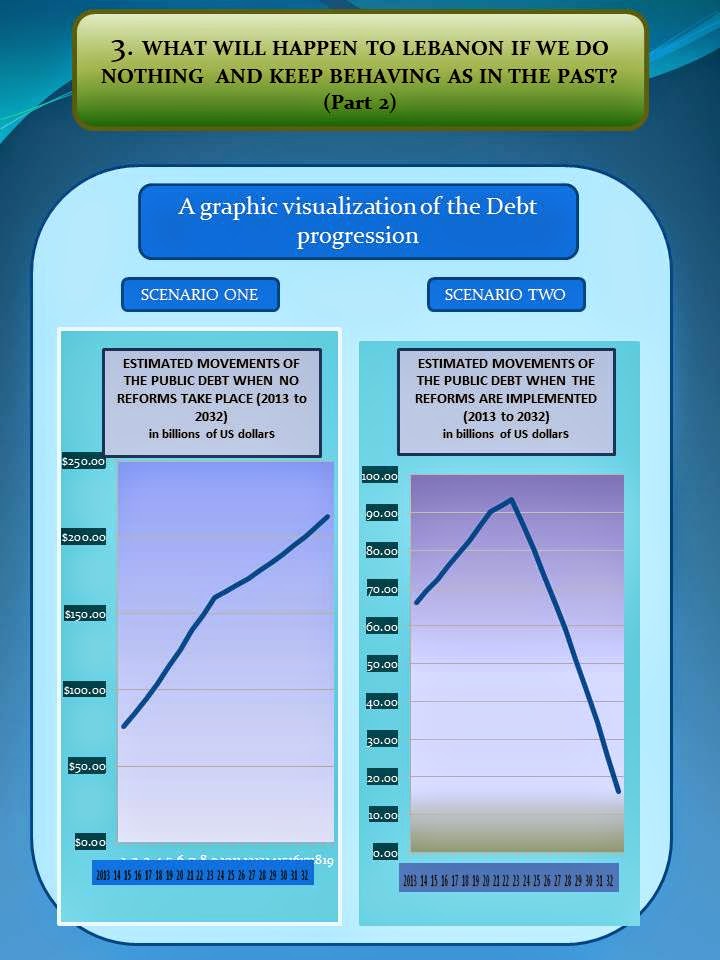
3)     What will happen to Lebanon if we do nothing and keep behaving as in the past (part 2)

4)      What is CPI's Mission?

5)      How does CPI intend to fulfill its objectives through the L.N.D.P.?

6)       The list of the L.N.D.P. sector Plans.

7)      How can the L.N.D.P. assist CPI in attaining its objectives in Lebanon?

8)      How can the citizens, and Youth in particular, participate in the L.N.D.P. project?


9) The merits of participative governance (part 1)


10) The merits of participative governance (part 2)